Ontoforge
The semantic system of record for your enterprise. Derive a formal model of the systems you already run, govern how it changes, and prove where every answer came from. Built from your schema and your logs — without hand-crafting a single Turtle file.
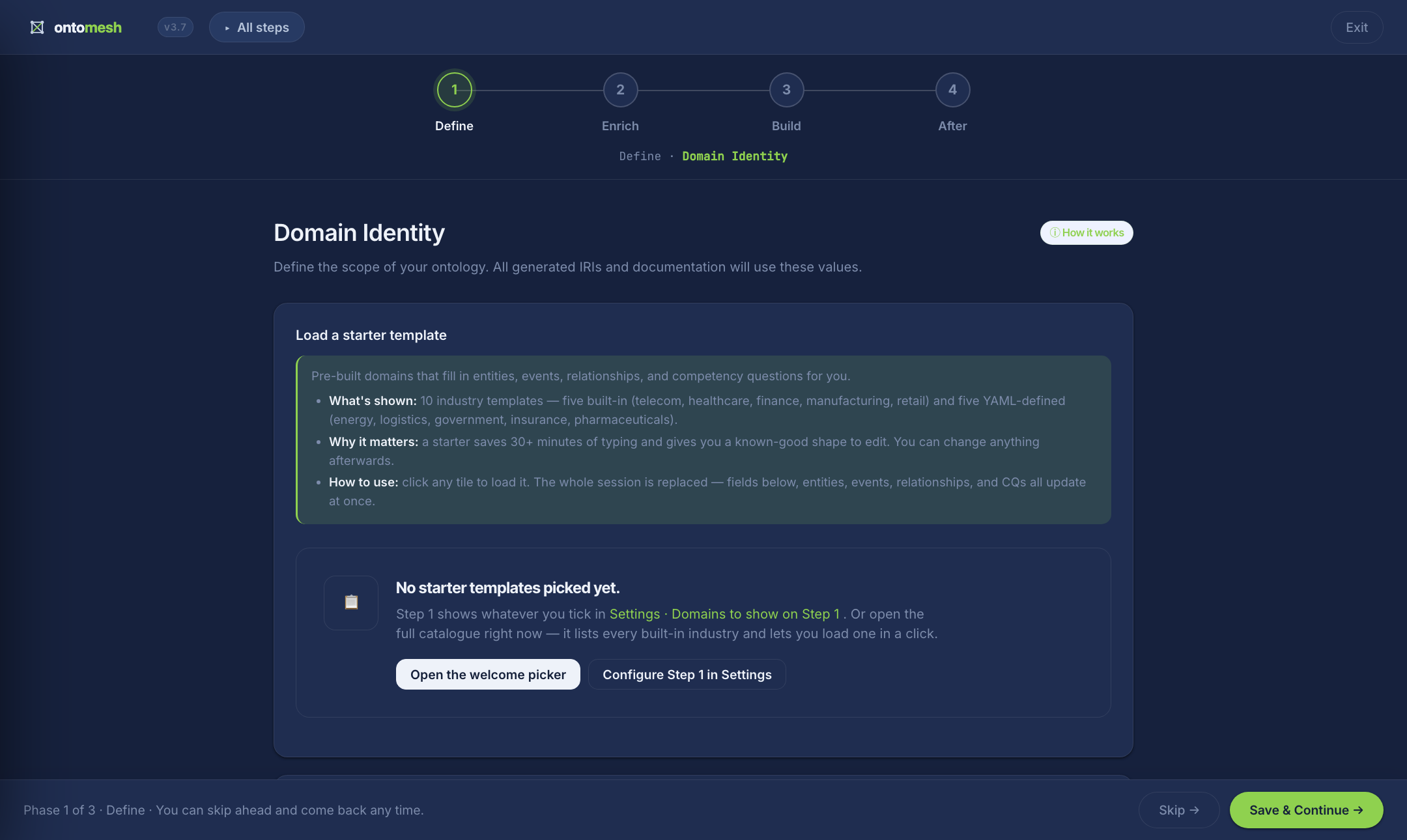
The guided wizard (Twilight theme) — Define → Enrich → Build → After. Also ships Mono and Light themes.
A guided tour
From landing page to ontology-grounded reasoning search, in order.
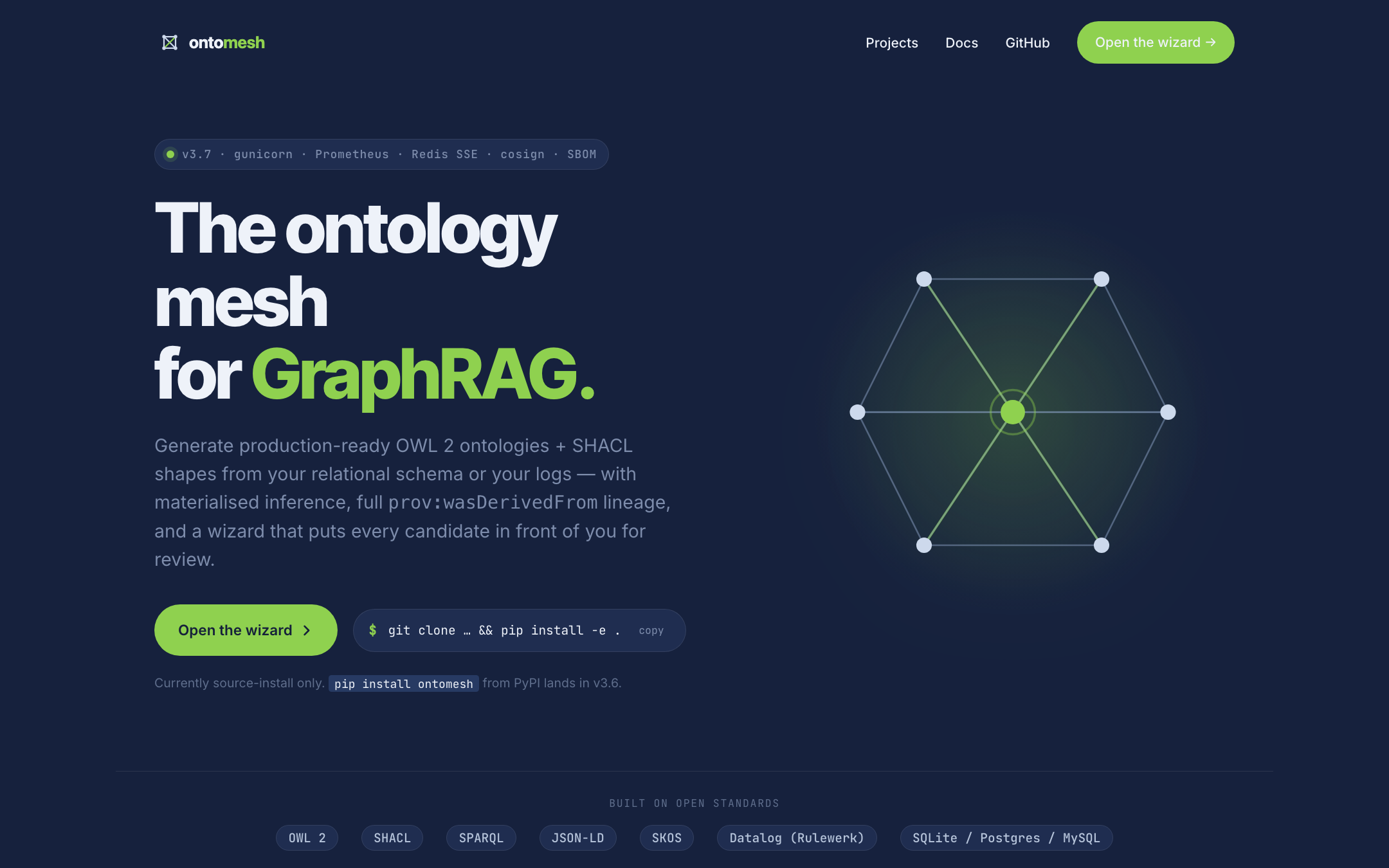
1. Landing — the marketing entry point.
2. Model your domain — the Twilight wizard walks you from a domain to a generated ontology in four phases (Define → Enrich → Build → After).
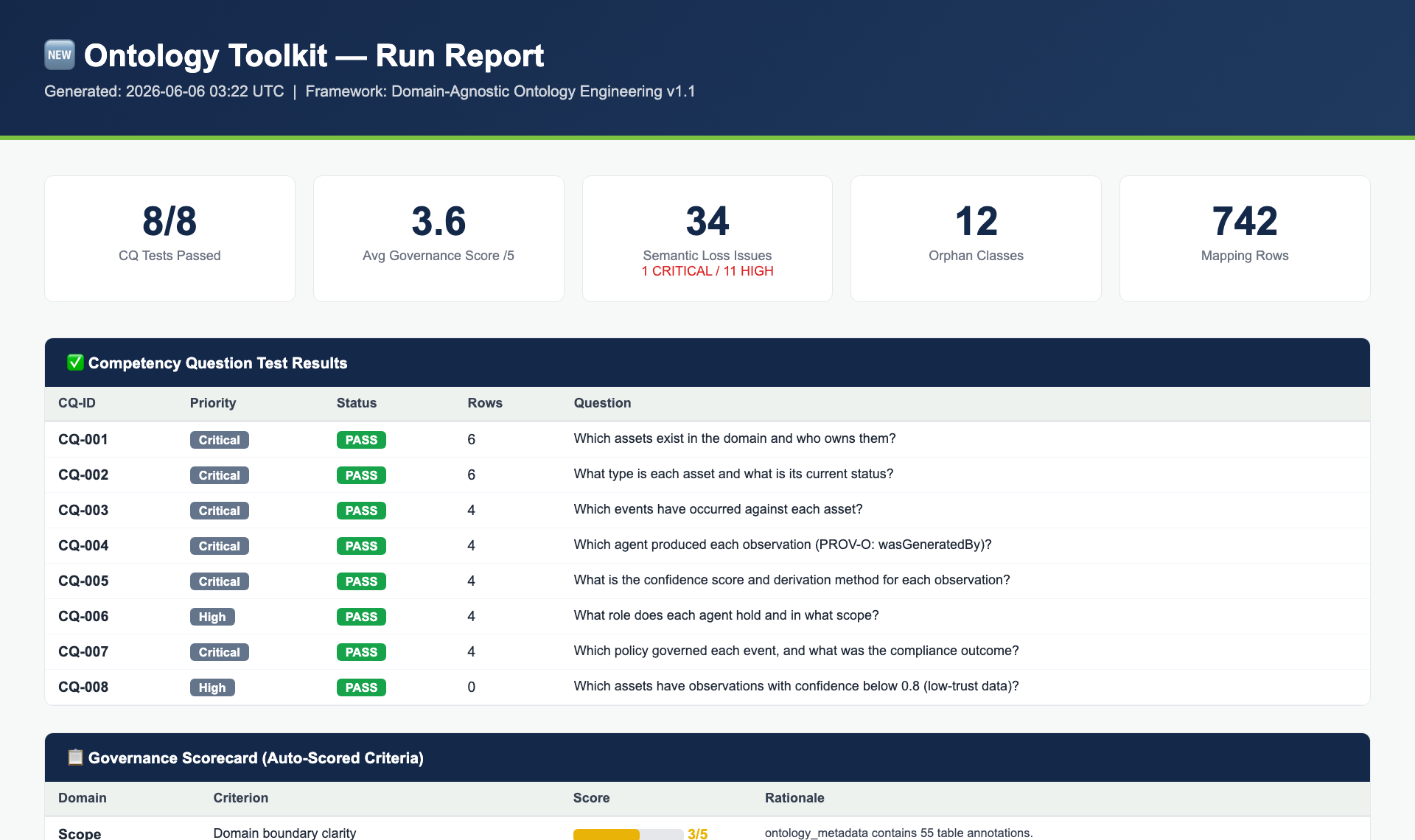
3. Run report — every run emits a branded HTML report: competency-question results, governance scorecard, semantic-loss analysis, and orphan-class checks.
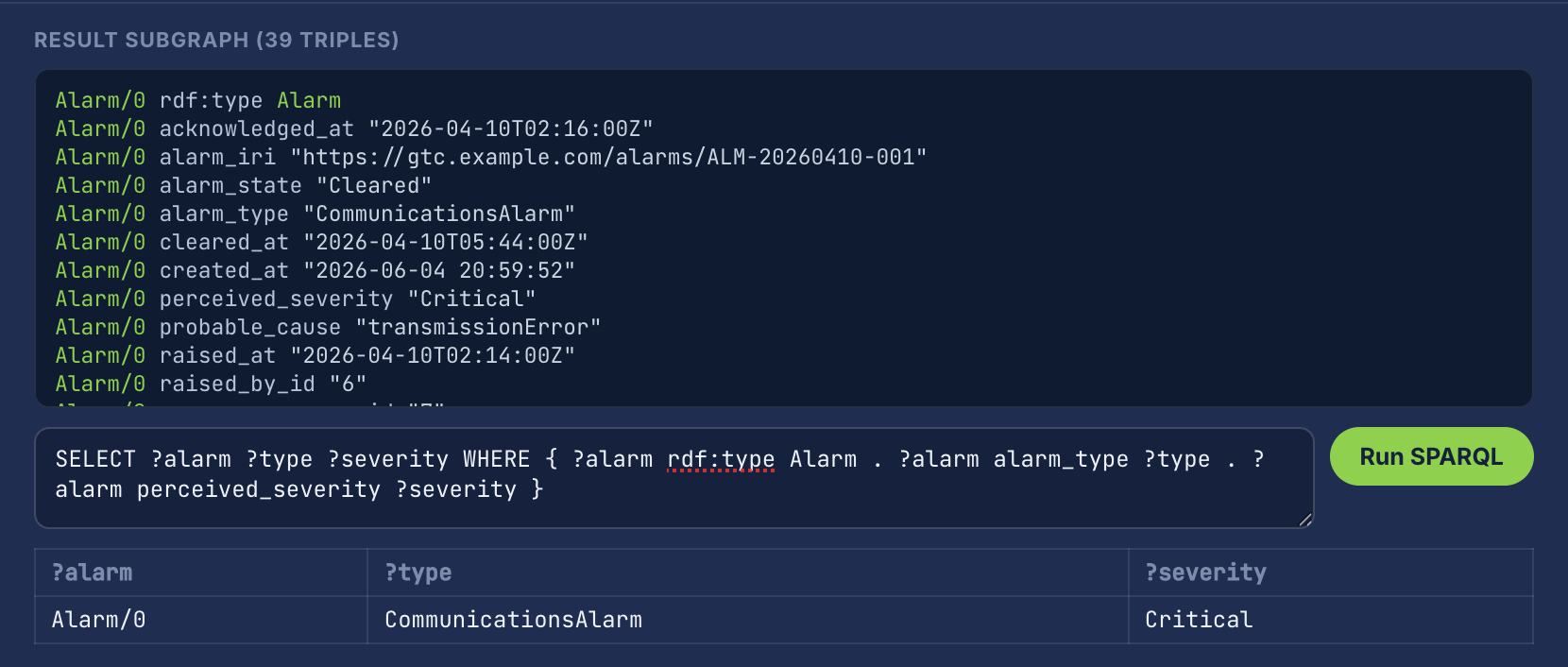
4. Ask — pose a question — the read-only, ontology-grounded Ask console. Pick a flavor and provider (Ollama / OpenAI), set your sensitivity-tier ceiling, and optionally build an RDF subgraph for live SPARQL.

5. Ask — a cited, reasoned answer — the answer cites its sources, shows the read-only SQL that ran, materializes the result subgraph, and streams the full reasoning trace (plan → execute → relations → reason → synthesize).
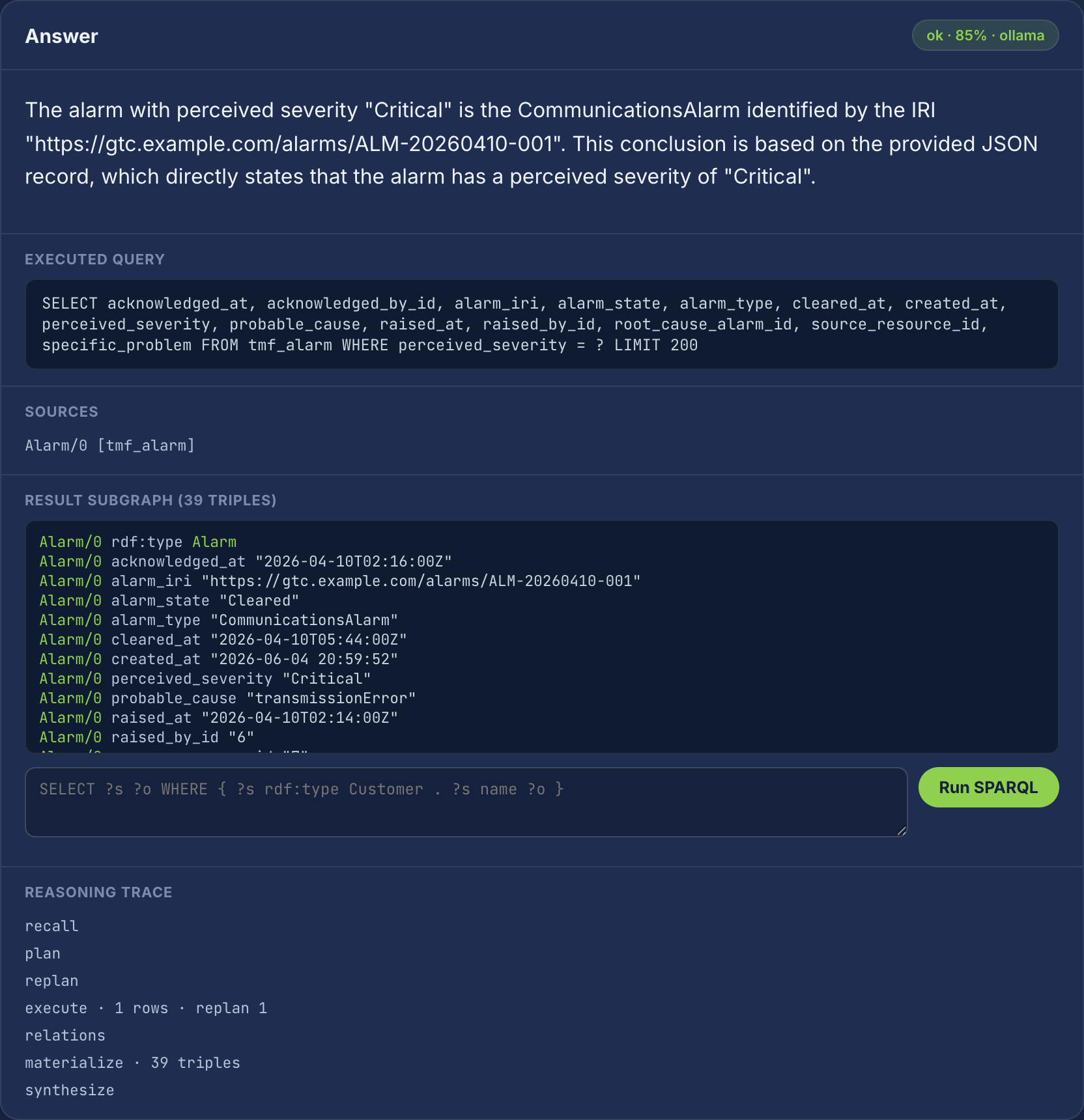
6. Ask — live SPARQL over the result subgraph — interrogate exactly what
grounded the answer with a SPARQL SELECT over the materialized RDF triples.
What ships in the box
| 8 pipeline phases | Domain → Entities → Events → Relationships → SHACL → Generation → Evolution → Compliance |
| 8 enrichment phases | Log mining L4–L13 (template clustering, HMM regimes, Granger causality, PMI co-occurrence, switching SSM, …) |
| OWL 2 DL output | Real class expressions, defined classes, owl:hasKey, PROV-O chains, OWL-Time, QUDT — see the ontology model |
| Instance data | --phase abox materialises individuals from your rows, tier-gated — see artifacts |
| Self-checking output | Pitfall detection, structural metrics, consistency, and a CI ratchet — see quality gates |
| 10 starter industries | Telecom, healthcare, finance, manufacturing, retail, energy, government, insurance, logistics, pharma |
| 6 database backends | SQLite (default), Postgres, MySQL, MSSQL, Oracle, DB2 |
| 5 LLM adapters | Anthropic, OpenAI, Vertex AI, Ollama, OCI |
| 2 vector backends | FAISS, Chroma (scaffolded: Qdrant, pgvector) |
| 5 deploy targets | Docker · Compose · Fly.io · Render · Cloud Run |
Two-line install
Trust signals
- Apache-2.0 — full source, no proprietary core.
- Cosign-signed images — keyless OIDC, verifiable trust chain to
synaptixs/ontomesh. - SBOM + SLSA provenance — every release ships SPDX SBOM and SLSA attestation as OCI artefacts.
- 297+ tests running on every PR.
- Public roadmap + changelog — no surprises.
Pick a path
-
Just want to run it?
A single
docker runbrings the wizard up locally. No accounts, no credentials. -
Want to understand it?
Read how the pipeline phases compose, what SHACL gives you, and why we mine logs.
-
Deploying to production?
Pick a managed runtime, wire up Postgres + Redis, harden the image.
-
Integrating it?
SDK, REST endpoints, MCP tools, JSON-LD artifacts — all the surfaces.
What's new in 3.8.0
- Reasoning Search — ask your database in plain English and get a
cited, ontology-grounded answer with a live SPARQL subgraph. See
Reasoning Search. (Flag-gated:
ONTOFORGE_SEARCH=1.) - First PyPI release under the
ontoforgename (pip install ontoforge); GHCR image path unchanged. - Prometheus
ontomesh_search_*metrics + a bundled Grafana dashboard (deploy/monitoring/).
What's new in 3.7.0
- Apache-2.0 licence + NOTICE + SECURITY.md + Contributor Covenant CoC
- Public image at
ghcr.io/synaptixs/ontomesh:3.7.0, cosign-signed, SBOM'd, SLSA-attested - gunicorn (gthread) replaces the Flask dev server; multi-worker safe via Redis SSE bus
- Differentiated
/live+/readyprobes; structured JSON logs withX-Request-Id - Prometheus
/metricsendpoint with cardinality-bounded labels